
Susitna 100 Racer Guide
RULES, REGULATIONS, RECOMMENDATIONS AND EVERYTHING TO KNOW BEFOR YOU STAND AT THE START LINE. Race weekend
Schedule & Check-In
Pre-Race ChecksThursday, February 11 2027
3600 Denali Street, Anchorage, AK
6:00 PM Mandatory Gear Check
7:00 PM General Meeting and Trail Briefing
RACE DAYSaturday, February 13 2027
Happy Trails Kennel | 19391 W Lakes Blvd, Big Lake, AK 99623
7:30 - 8:45 AM: Racer sign-in
9:00 AM Race Start
CELEBRATIONMonday, February 16 2027
Anchorage Moose Lodge | 4211 Arctic Blvd, Anchorage, AK 99503
6:00–9:30 PM Post-Race Celebration
IMPORTANT: Racers declare their division (bike, foot, or ski) at sign-in. If a racer is not signed in by 8:45 or needs gear re-inspection, they will have to wait until after the race start to do so. Racers who don't sign in can not participate in the race.Race rules
& Regulations
-
All racers must be 18 years old by the day of the race unless approved by the Board of Directors.
-
Any racer with a dog on the course will be disqualified. Please do not bring your pets to the race! The race start/finish is at Happy Trails Kennels – this is a working Iditarod dog team kennel. We are guests of this business and must be considerate!
-
We know you have friends and family who want to track your progress during the race. Please ask them to do so via the website, which will be updated with results throughout the race if weather and conditions allow. During the race, our phones are used to contact checkpoints and facilitate racer safety. If a true emergency arises, and someone must contact a racer or race personnel, then this number may be used 907-232-2553. In the history of the race, only four or five such situations have arisen. Events such as death in the family or imminent birth of a child come to mind. Arranging post-race transportation is NOT an emergency.
Please do not call any of the checkpoints including Happy Trails Kennel. -
Racers will be disqualified for littering.
Racers are not allowed to leave wet or discarded clothing or gear at any checkpoint.
If you start with it, you finish with it (no drop bags).
-
Racers may accept help only from race officials or other racers. Race officials may not provide assistance that moves a racer forward along the course.
-
100 mile racers must sign into and verbally check out of each checkpoint.
Any racer who misses a checkpoint will be disqualified.
Non-racers who are on the course to follow racers (or for any other reason) are not permitted in checkpoints.
-
Racers must follow the marked race route (no short cuts).
-
All 100 mile racers must adhere to the cut-off times for checkpoints as presented at the Pre-Race Briefing. Total time allowed for the 100 mile course is 48 hours.
See the Susitna 100 Course Description for specific cut-off times.
-
If you are taken from the course by a race official via snowmachine, plane or other transport, you will be charged an evacuation fee of $200.00. Be prepared to pay this fee upon arrival at the Headquarters.
Self-evacuation from Pt. Mackenzie or the Willow Community Center via the road system by your own means will not be charged the evacuation fee but you MUST notify a race official.
-
You'll provide an emergency contact's name and phone for race weekend. That person authorizes a search by Civil Authorities if you fail to check out at the finish. Racers are responsible for the cost of any such search.
Register before January 1 to guarantee your shirt size. All racers get a shirt; all finishers get an award.
The Board reserves the right to refuse entry.
-
Entry fees are valid for the current race only. They are non-refundableand non-transferable.
Alaska Winter Wilderness Races Board of Directors reserves the right to cancel race(s) for safety reasons. Refunds options should this occur will be determined by the Board and registered racers notified
Required Gear
Every racer carries these items, every division, no matter the forecast. Your gear must pass inspection at the MANDATORY gear check meeting. If it doesn't, it gets re-checked after the 9:00 AM starting time.
-
The Susitna 100 requirement for a sleeping bag is: A one piece sleeping bag (no combination of liners) rated to at least -20 degrees Fahrenheit (20 degrees below 0 degrees Fahrenheit, =28.8 degrees below 0 degrees Celsius).
Many sleeping bags now are rated by the EN 13537 testing standard. To use this rating system to meet the Susitna 100 requirement, look at the lowest limit of comfort. Please note, this is NOT the T extreme. Information about the EN 13537 is available on the European Outdoor Group website. If you have questions about the application of this rating to the Susitna 100 sleeping bag requirement please e-mail info@susitna100.com.
There is a good selection of lightweight synthetic bags that will meet this requirement. However, your best bet is to get a down bag, preferably with a goretex shell (in case you actually do have to use the bag). Down fill is still lighter and more compressible than any synthetic fills of comparable insulation rating.
Be aware that the insulating value of sleeping bags degrades over time and is quite sensitive to the care the bag receives from its owner. Thus the label you show the Susitna 100 official at check-in may indicate that the bag meets the specification, but your personal field-test may determine a much different (and quite uncomfortable) rating.
Some racers sleep during this race. If you stop for a few winks, don't expect to find floorspace at a checkpoint. In short, think about your race plan and factor in how you plan to bivouac in the open at 20 or 30 below zero F. -
Any sleeping pad is acceptable. If you are going to use an inflatable pad, you should strongly consider an insulated one with a higher R-value. Minimum size is 20" x 48".
-
NO space blankets. A goretex bivy sack is recommended.
If you're not into ultra-light hiking and/or climbing you probably don't own one and the $100+ cost may be prohibitive. The one-person tents marketed to bicycle tourists are fine, but will add some ounces to your gear.
Again, you're not likely to use this equipment. But if you do, it's important that your bivy sack be waterproof, especially if your sleeping bag isn't. If you do bivouac, dig or stomp out a trench in a snow bank (not too far off the trail) and use the trench for wind protection and extra insulation. -
The rule says nothing more than the preceding three words and thus virtually any device you bring to the check-in will be in compliance. Before selecting your light, consider the following rather contradictory factors:
Winter nights in Alaska do not typically have the same intense darkness you encounter in warm climates where there is rarely any snow. Snow is highly reflective and can achieve great definition with even a small amount of light. However, because some sections offer technical riding on the course, avoid the temptation to cut corners with your lighting system.
The wilderness through which the Susitna 100 is run is criss-crossed with a number of winter trails. The race course intersects many of these trails, some of which have proven quite alluring. The course is well-marked with reflective tape posted on trees and wooden stakes, a long, wide beam of light will catch these markers day or night. Bring extra batteries.
-
For traveling at night or camping, a small flashing light will alert snowmachines and other people on the trail as to your presence. If you camp for the night, hang the light from a nearby tree, a ski pole, or your bike, so roving race officials can take note of your location.
-
We require that you have at least a two-quart (64 ounce) capacity. If you dress properly and avoid sweating, this should be enough to get you between checkpoints. A special note to runners and snowshoers: you will be constantly cycling between hydration and dehydration and you must be disciplined about re-hydrating at checkpoints. It is advisable to carry an extra quart bottle (start with it empty) just in case you figure out that you are not keeping up.
Outdoor Research (OR) makes nice bottle jackets. If it's a cold year (or you are broke), you can make your own out of a sheet of one-inch foam rubber and some duct tape. The plastic bladder (Camelbak, Platypus, or other name brands) is overwhelmingly the weapon of choice. Most competitors are well-informed as to their virtues. Bladders, however, aren't trouble free. Racers must be alert to the tendency of hoses to freeze, especially during the longer periods between checkpoints with which runners and snowshoers must contend.
Try any or all of the following:Wrap the drinking tube with adhesive-backed pipe insulation, available at most plumbing and hardware stores;
Run as much of the tube as possible under your clothes and use body heat to maintain a working temperature;
Clear the tube after drinking by either blowing back into the tube or raising it while pinching the tip.
In 1993, a racer got second-degree burns on a good portion of his back when his bladder was filled with near-boiling water. He was a mile or two out of the checkpoint, with the bladder buried under layers of clothing, before he realized he was about to become a soft-boiled egg. Think about the outside temperature and the body heat you're generating when you fill those bladders. They can provide a welcome heating pad during a cold stretch or they can turn your clothing into a steam room and sweat you to dehydration.
Bladders can and will leak or siphon their contents everywhere but where the fluid needs to go: into your mouth. Avoid these problems by selecting a dependable valve and then gluing or taping it onto the tube. As with all of your equipment, work with your drinking system, under winter conditions if possible, before the race to find and cure its weak points. -
May be consumed after the last checkpoint
You must leave the last Checkpoint with one day of food. Food and drink mix should total 3,000 calories.
You will have limited opportunities to beg, borrow, or buy food along the trail; hence plan on being completely self-sufficient for calories. All the checkpoints will have water, so bring lots of drink mix to add calories, electrolytes, caffeine, and other good stuff to your body. Unless you are willing to carry the food next to your skin, choose food that does not freeze solid at extreme temperatures. Some racers carry food to be heated up on the wood stoves at the checkpoints, such as foil wrapped pizza or sandwiches. No conventional cooking appliances are available for racer use.
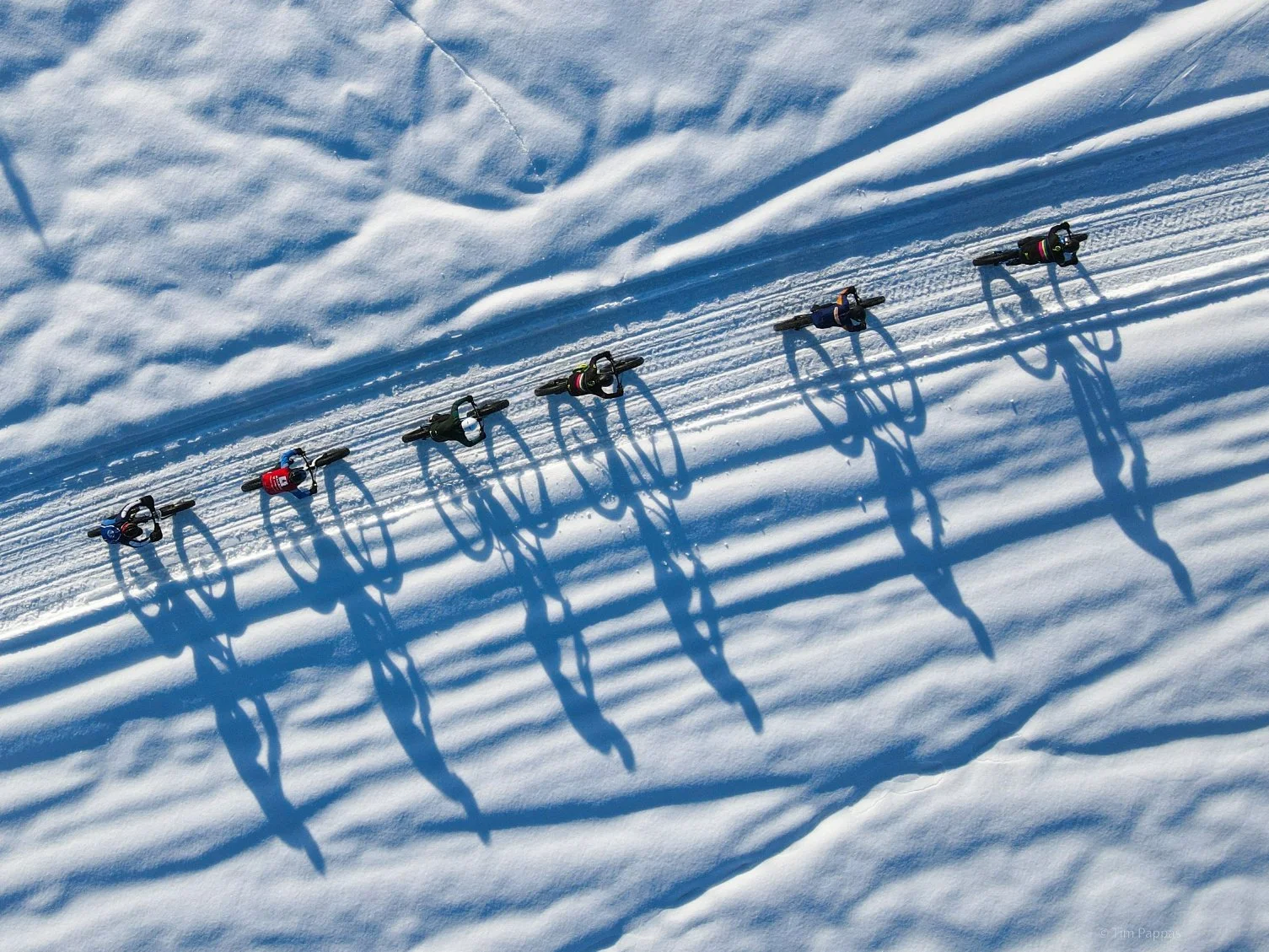
bike, Run, SKi gear guide
Recommendations and requirements for your chosen means of travel.
Mandatory Gear Check
All Susitna 100 racers MUST attend the gear check and pre-race meeting.
Thursday, February 11th, 2027
Loussac Library / Wilda Marston Theatre
3600 Denali St, Anchorage AK
Gear check will begin at 6:00 pm. The general meeting and trail briefing will follow about 7:00 pm.
Please make sure you have ALL of your required mandatory gear with you including food.
Do NOT bring your bike, skis or sleds into the facility.
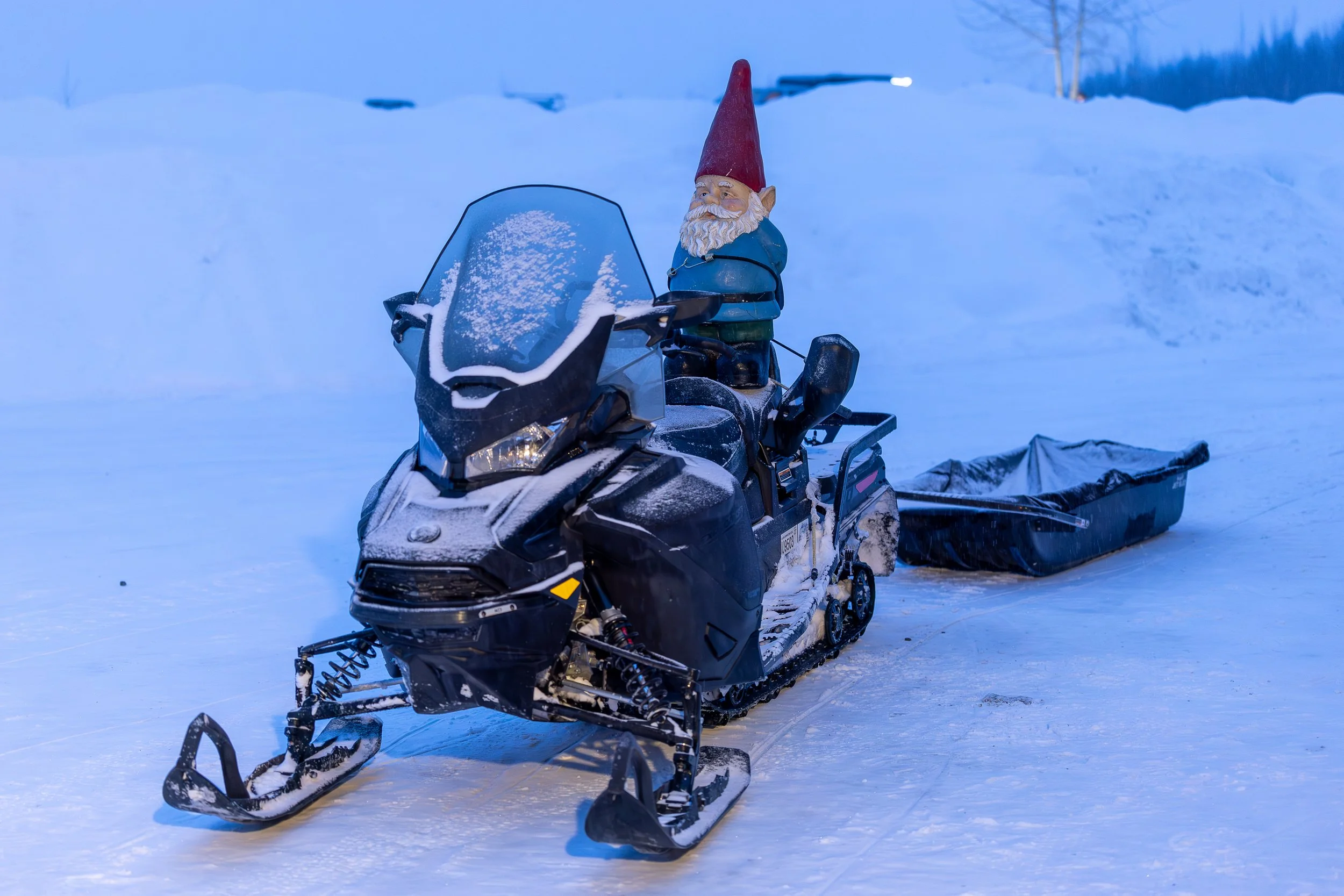
Directions and Parking
The race starts and finishes at Happy Trails Kennels, Mile 4.5 West Lakes Blvd, Big Lake, Alaska. Allow about two hours driving from Anchorage.
From Anchorage:
North on Hwy 1 (Glenn Highway)
Hwy 1 becomes Hwy 3 (Parks Highway)
Continue through Wasilla
Left on Big Lake Road at Mile 52
About 3¼ miles on Big Lake Road
Right onto Beaver Lake Road
Continue 1 mile
Left onto West Lakes Boulevard ("W. Lks. Blvd.")
About 4½ miles
Right at the sign for Happy Trails Kennels
Checkpoints
& Cutoff times
Observe every cutoff announced at the pre-race briefing. These cutoff times were carefully constructed over the years to ensure the probability of your success and safety.
Participants must leave the checkpoint by the departure cutoff time. No exceptions will be given for conditions, etc.
START: HAPPY TRAILS KENNEL
Mile 0 • 100 to Finish • 22 to Next CP
Departure Cutoff: 9:00 AM Saturday
PT. MACKENZIE PARKING LOT
Mile 22 • 78 to Finish • 12 to Next CP
Departure Cutoff: 4:00 PM Saturday
FLATHORN LAKE
Mile 34 • 66 to Finish • 19 to Next CP
Departure Cutoff: 9:00 PM Saturday
5 STAR TENT CAMP
Mile 53 • 47 to Finish • 17 to Next CP
Departure Cutoff: ––
WILLOW COMMUNITY CENTER
Mile 70 • 30 to Finish • 16 to Next CP
Departure Cutoff: 3:00 PM Sunday
COW LAKE
Mile 86 • 14 to Finish • 6 to Next CP
Departure Cutoff: 12:00 AM Monday
HOME STRETCH
Mile 92 • 8 to Finish • 8 to Next CP
Departure Cutoff: 4:00 AM Monday
FINISH: HAPPY TRAILS KENNEL
Mile 100 • 0 to Finish • 0 to Next CP
Departure Cutoff: 9:00 AM Monday
CHECKPOINTSTART: Happy Trails KennelPt. Mackenzie Parking Lot5 Star Tent CampWillow Community CenterCow LakeHome Stretch0
22
34
53
70
86
92
100
78
47
30
14
8
TO NEXT CP22
12
17
DEPARTURE CUTOFF9:00 AM Saturday
4:00 PM Saturday
Flathorn Lake66
19
16
9:00 PM Saturday
–
6
3:00 PM Sunday
8
12:00 AM Monday
4:00 AM Monday
FINISH: Happy Trails Kennel100
0
0
9:00 AM Monday
TO FINISHMILEEmergency & Safety Information
-
Getting wet in sub-freezing temperatures is a life-threatening situation, and several rivers on the course are prone to overflow regardless of the weather. Going an extra couple of miles to skirt overflow is worth it. Carry a couple of heavy-duty trash bags you can wear like waders through shallow overflow.
-
Drink early and often, at least a pint an hour. Don't overdress. If you start feeling dizzy or losing motor control, get fluids and carbohydrates in you and change into dry clothes.
-
Wind is the main culprit. A face mask or duct tape across the nose helps in a headwind. If your fingers or toes go, get warm layers on them fast. If you get frostbite or think you have it, head to the nearest checkpoint, ahead or behind. Don't tough it out.
-
The trail is marked with roughly 1,000 lath stakes hand-labeled "SU 100," reflective on both sides. If you go more than 15 minutes without seeing a marker, you should consider backtracking til you see a SU100 lath.
Other groups mark their own trails out here — follow only the SU 100 markers.
-
For true emergencies only: 907-232-2553. That means things like a death in the family or the imminent birth of a child. Arranging post-race transportation is not an emergency. Do not call checkpoints, including Happy Trails Kennels.
Withdrawing from the race
Self evacuation (no fee):You can leave the course via the road system from Pt. Mackenzie or the Willow Community Center without an evacuation fee, but you must notify a race official first.
Official evacuation ($200 fee):If a race official transports you off the course by snowmachine, airplane, or other means, a $200 evacuation fee applies, due on arrival at Race Headquarters. Weather, daylight, and equipment availability determine the method.
Either way: if you're in trouble, get to a checkpoint or flag down a trail patrol.